Learn About Sandcastles

Learn Physics of Sandcastles too!
Let Your Sandcastle Building Become an Educational Adventure!
Learn about sandcastles and let your sandcastle building turn into an educational adventure as you learn about the physics of sandcastles, Castle Terminology, Fun Sand Facts and more!
Give a plastic bucket and a shovel to a kid, then turn 'em loose on a beach full of sand and they will happily play the day away building the sandcastle of their best imagination!
Playing in the sand all day is pure simple fun! But how about letting it be educational at the same time!
Sandcastle building involves nothing but sand, water, and your creative imagination -- or wait a minute, does it?
What about the physics of building sandcastles?
Physics of sandcastles...What?
Yep!
There's some serious physics to sandcastle building too. Take advantage of this fun learning opportunity with your kids and let their creative juices flow...at the beach!
To learn more about the physics of sandcastles, keep reading...
The physics of sandcastles and what makes them stand strong and solid certainly is intriguing! It even intrigues NASA.
NASA has sent samples of sand aboard spacecraft on three missions to study its properties in the absence of gravity (attracting force between two objects).
Sandcastles are built from grains -- billions of tiny sharp-edged particles that rub and tumble together.
The strength of a sandcastle depends on how the grains interact.
What happens when they're wet?
It's not only beach-goers who are interested; farmers, physicists and engineers want to know, too.
Scientists mostly understand why sand on a beach behaves as it does.
Damp sand sticks together because water forms little grain-to-grain bridges.
Surface tension -- the same force that lets some insects walk on the surface of a pond -- acts like strong rubber bands between the grains, bonding them firmly together.
Adding water to damp sand fills spaces between the grains. The bridges vanish and the sand begins to flow more easily.
Why would NASA want to study the stuff in space?
Granular mixtures like sand have two different personalities:
They can flow like liquid and be solid at the same time. (For example, you can both pour sand and walk on it.)
If scientists can figure out how granular mixtures morph from solid to liquid, the results could benefit industries from building construction to food processing.
"We're trying to determine if wet sand sticks together in space the same way it does on Earth," says Stein Sture, NASA's lead investigator of the mechanics of granular materials.
But you don't need a space shuttle to learn about sandcastles and the physics of sandcastles.
If you want to turn your sandcastle building adventure into an educational learning adventure for your kids, I’ve put together some scientific facts right here from NASA on the physics of sandcastles and the science of sand and water and -- just what is it that makes a sandcastle stand?
It’s always fun to learn and have fun while you’re learning so let your kids learn the physics of sandcastle building and -- just what is it that makes a sandcastle stand?
OK, now go have some family beach fun with your kids and do your own sandcastle building!
Then take pictures and come back here and post your cool sandcastle pictures!
What is it about kids and sandcastles?
All kids love to make sandcastles at the beach!
When kids build sandcastles, they begin by gathering water from the ocean to wet the sand.
Not too much water or it gets too goopy -- just enough to make sand stick together without oozing.
Next they pack the damp sand into a bucket, and flip it over to create an extra-strong base for a tower for their sandcastles.
Photo Credit: Tony Newell
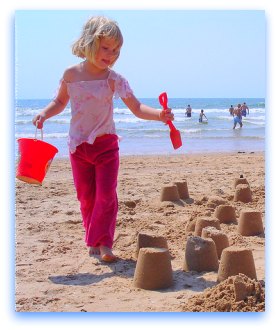
Kids love to build the towers taller and taller--until a wall suddenly caves and the tower slides into the moat.
Kids love to make sandcastles by letting watery, goopy sand drip from their fingertips, solidifying in place to form odd-looking stalagmites.
What's a stalagmite? To find out what a stalagmite is, download your free sandcastle terminology guide, right here.
This may sound like just fascinating news for the under eights, but understanding how granular materials behave is very important in understanding soils, concrete and the stability of slopes, amongst many other things.
It's something to think about the next time you're building a sandcastle: inside the moat lies some far-reaching physics of sandcastles.